Add Exception Rule
An exception rule is used to monitor the status of managed resources in real time. When the resource is exceptional, the resource will push a notification to the Hik-Partner Pro to notify the specified Installer(s) about this exception. Currently, the exceptions include two types: device exceptions and channel exceptions.
-
Make sure you have the permission for configuration of the device (if the device supports). For applying for configuration permission, refer to Apply for Device Permission.
-
Make sure you have enabled the device to send notifications to the system (if the device supports). For details, refer to Enable Device to Send Notifications.
You can add a rule to define such an exception. The rule contains five elements, including Source (device A or channel A), Exception (the exception occurred on device A or channel A), Received by (the source pushes a notification to notify the recipient via certain ways), Recipient (who can receive the notification), as well as Schedule (when the recipient can receive the notification).
This function is not supported by the solar camera.
-
Tap the name of a site to enter the site details page, and then tap
Exception at the bottom.
The exception rules of all the devices added in this site are displayed respectively.
Figure 1 Add Exception Rule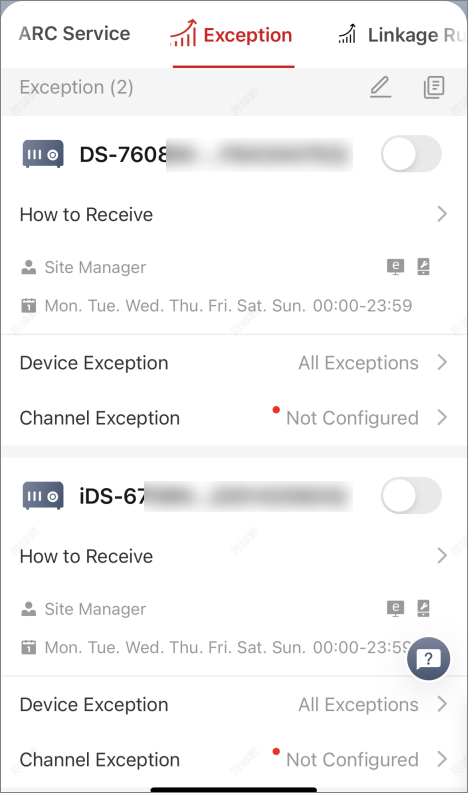
-
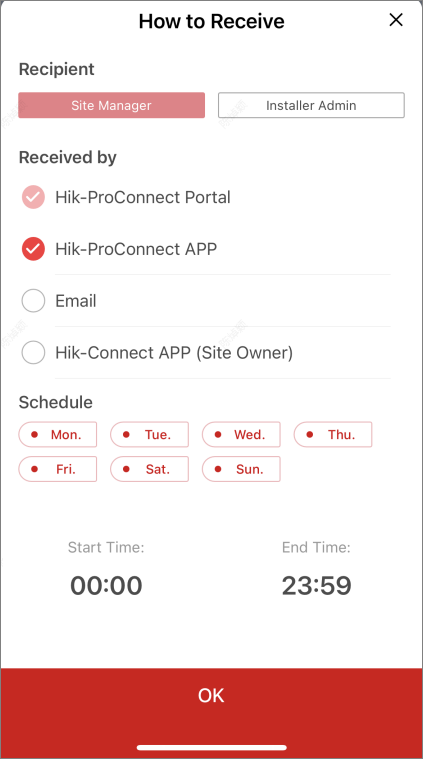
Tap How to Receive on one device panel to set the
Recipient, Received
by, and Schedule in the
rule.
Figure 2 How to Receive
- Optional:
Set the exception rules of the devices in the site in a batch.
-
Tap
 .
.
- Check the devices or channels you want to set the exception rules, and tap Next.
- Set the exception types including device exception or channel exception, and tap Next.
- Set the receiving mode, recipient, and time.
- Tap Finish to save the settings.
-
Tap
- Optional:
After setting one rule, you can copy the rule settings to other devices or
channels for quick settings.
-
Tap
 .
.
- Select device(s) or channel(s) as the sources to copy from.
- Select the target resources of the same type as the selected sources.
- Tap OK to copy the rule settings of the sources to the target resources.
-
Tap